Thursday, 2 December 2010

Misfits strangling scene inspiration

Misfits; Series 2 episode 1
Although Misfits isn't a thriller we could still use it as an influence for our thriller opening.
       In this specific scene they have used various close ups of the knotted hands, his face covered by the bag and his chest area to create a convincing "strangling". I thought we could perhaps use these ideas if its too hard to kill somebody with a plastic bag alone, we could consider the idea of the girls hands being tied together. Perhaps she could wake up, after having been knocked out, tied up in a room where she is then strangled. However this idea would make it difficult for us to include the thugs.


Wednesday, 10 November 2010

Analysis of the Third Man and Generic thriller conventions

The Third Man is a film directed by Carol Reed in 1949. The film won an Oscar, and won 2 of 4 nominations. It is the story about a man named Holly Martins who arrived in Vienna to visit his friend Harry Lime, who he finds has recently passed away in a car crash. Holly sets about to find out whether its true if Harry is dead. The predominant actors include Orson Welles, Joseph Cotton and Alida Valli.


User review taken from IMDB
"This is a rare film that is flawless in every respect. It combines great acting and memorable characters with a fascinating story, taking place in an interesting setting and adding a creative musical score. "The Third Man" is remembered for many things - for Orson Welles' wonderful performance in his appearances as Harry Lime, for its wonderfully appropriate musical score, and for its nicely conceived plot surprises. Adding to these is Joseph Cotten's fine portrayal of Holly Martins, which holds the rest of it together - it is his character who initiates most of the action, and also through whom we view everything and everyone else."


Professional review from The Guardian
"Watching it again, the theology of the piece is what emerged for me: the strange and sinful presumption of Harry Lime (Orson Welles) in faking his own death, the succession of betrayals in the lives of his friend Holly Martins (Joseph Cotten) and tragically loyal girlfriend Anna (Alida Valli), and Lime's gloomy afterlife, a damned soul in Vienna's hellish sewers.... What redemption can there be for Harry Lime, the grotesque exploiter of sick children? Could Anna and Holly's own growing love for each other, a sadder and wiser love, constitute some kind of secular forgiveness? A great film."
  

The title sequence begins of a full screen shot of a cultural signifier- a Zither. A Zither is a musical instrument common in Austria, this has been done to instantly tell the audience where it is set. The audience are able to hear Non diegetic sound- "The Harry Lime theme"  which acts as a personification of Harry Limes character;  upbeat, cheeky and attractive. It also relates to the common phrase "pulling someones strings" implying that Harry Lime knows how to pull peoples strings.
       The film begins with various shots of war torn Vienna. At the time Vienna was divided into four parts and was governed by allied forces; France, America, Russia and Britain. We hear the Voice over of an anonymous British voice (the use of an anonymous narrator creates a sense of mystery) who mentions Vienna's old "Glamour and easy charm", this could even be considered as a reference to Harry Limes character. He goes on to further mention the thriving black market after the war, this implies that the narrator had some involvement within the black market creating an element of darkness and worry. We then see the sign
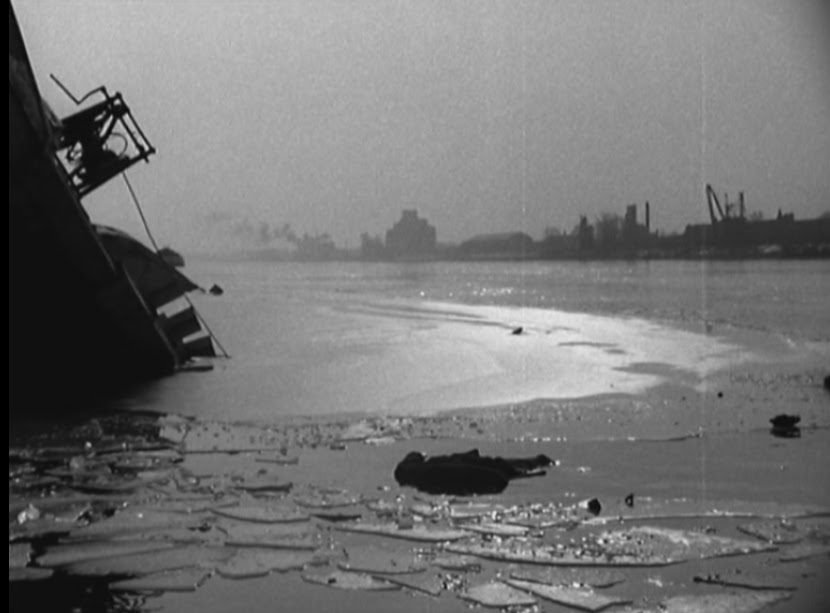
   We then see an image of destroyed Vienna, which shocks the audience and creates sympathy. A boat is on its side and sinking- much like the people of Vienna and Holly if he continues to seek Harry. This also implies that there was a lot of trouble in Vienna at the time and what was once a thriving proud capital city had "sunk". Also we see a dead body lying amongst rubble, and ice. The film setting refers strongly to the films theme of corruption which is a common theme in thrillers. 
     We are then introduced to one of the main characters Holly Martins. The audience see a low angle shot of a silhouetted stream train, the use of the train is highly generic in thrillers as it creates high amounts of tension and mystery as we wonder who is getting off the train and why they have come to the new uncertain place overall making the audience feel anxious for them as they are in a state of venerability. Holly Martins is introduced wearing a Generic style costume of a thriller character, he is wearing a long coat, trilby hat and he is carrying a briefcase. This shows his character as mysterious and important as his hat and coat cover him and allow him to hide himself and the briefcase is a typical reference of mystery as it acts as an enigma. We then see a long shot is taken of him walking through the streets of Vienna, we then see him walk underneath a ladder. This acts as an ironic poke at superstition and foreshadows that bad things will happen to him, which in a sense could be considered dramatic irony.  
He then enters a building, the audience see him walking up a generic stairways from a high angle shot making him look small. Non-ambient lighting has been used to created a long haunting shadow; this could represent another side to Holly however I personally think it represents Harry Limes character. Reed has used almost the same shot further on in the film when Harry is in the sewers, because we fully see his shadow at this stage I believe it foreshadows that he won't be able to escape. Stairways are a generic location as people are extremely vulnerable to falling. We then see a low angle shot as we see the Austrian man he is talking to, this shot has been used to make the Austrian seem important and powerful. He is speaking his native language and Reed has chosen to use no subtitles. This has been done to essentially create confusion for the audience, to make it seem like a nightmare and to see through Holly's eyes. 

Analysis of various shots and characters and what thriller conventions have been used;

Use of canted shot;
The canted/slant/tilt shot is used frequently in The Third Man and is popular with the thriller genre as it can be used to mirror a character; to create a sense of nightmare and surrealism and also to connote imbalance, instability and transition.
*distortion

Setting;The location of the sewer plays an enormous role in The Third Man, and presents obvious thriller conventions such as Noir lighting, Claustrophobic spaces and the feel of a labyrinth. The use of the sewer firstly has been used by Reed to show that the only place where you are free is below the surface and acts as a reference to Harry's characters. He chooses to run to a "safe" location as above ground is like a maze, however we later find out that underground is too. The choice of location implies Harry is considered "a rat".


Anna Schmit;
Anna Schmit is the Femme Fatale within The Third Man, as the audience later find out she is in love with Harry- the charming villain, and her deviance is presented when the audience are made aware that she keeps false papers. She is an incredibly mysterious character, firstly the audience sense her mysteriousness when she is present at Harry's first funeral. In this scene she is considered as highly inscrutable as she shows no emotion as she watches her lover be put to rest, the audience can not tell what she is feeling. Secondly the audience feel she is mysterious when she is established as an actress. This instantly suggests that she is able to act, lie and to "wear masks" when she needs to and when she is forced to. The audience also view Anna as inscrutable and enigmatic as she walks away from Holly creating a very unexpected, unromantic ending.


Monday, 8 November 2010

Possible locations for thriller opening

I took various different photos where I thought would be an interesting location for our thriller opening, for my intitial ideas.

 This is a high angle shot of a hallway in my house, because of the many possible routes you are able to see, including two doors it gives a slight feeling of being in a labyrinth.
 I asked my mum to pose for me, whilst I stayed in the same position. It created a quite generic shot, with the shadow and claustrophobia.
This is the same shot however it is taken from a low angle


This was an attempt at noir styled lighting however I feel it is too dark and it is difficult to establish what is what.
This is an almost birds eye view shot of my bathroom, I really like the use of light and how it would contrast with the characters dark personalities and the dark incidents


Concepts Board for thriller film

This is a really poor quality image (click on it to see the original size) of a concept board for another thriller idea I had. This specific idea would be a psychological thriller due to the use of character; in psychological thrillers characters are not reliant on physical strength, but are reliant on their mental abilties. Psychological thriller change the generic thriller formula to an extent of emphasizing the characters as much as the plot. Psychological thrillers create the suspense needed for it to be considered a thriller by playing games, munipulating others or trying to destroy others mental state.

Monday, 1 November 2010

How does the film Witness (1985 by Peter Weir) present aspects of the thriller genre?

The film is the story of a young Amish boy who witnesses a murder, and policeman John Book goes into hiding in order to protect him. It is a 1985 film directed by Peter Weir, the film was nominated for over 25 awards and won 12 including 2 Oscars. The cast includes; Harrison Ford, Kelly McGillis and Danny glover.

User review sourced from IMDb
"I've seen hundreds, maybe thousands, of films, and when asked which is my favorite my decision keeps coming back to "Witness," Australian director Peter Weir's masterpiece. Fabulously acted, beautifully photographed . . . it's just perfect. Outside of the well-known stars (Harrison Ford, Kelly McGillis, Danny Glover) look for brilliant work from Josef Sommers and an amazingly understated performance by the late Alexander Godunov. "
Professional review from BBC film
"Harrison Ford stars as a disillusioned cop heading nowhere, when he becomes involved in a case that will radically change his perceptions. A young Amish boy (Lukas Haas) is witness to a murder in a train station where he and his mother (Kelly McGillis) have been travelling to visit her sister. It's a rare trip for them outside their puritanical Amish roots and only confirms their fear of a seemingly-violent outside world.....A lot of care and attention has gone into both the Oscar-winning screenplay and the beautiful cinematography, to create a powerful and romantic story. On that level this is a deep and moving film. But a tacked-on, Hollywood-style ending mars the tender emotions explored here. It spoils things slightly but arguably serves to remind us that such an idyllic lifestyle can't last forever."

Conventions and aspects of the thriller genre within scenes of Witness

This scene begins with Grand Central Station, a location also used in Once Upon a Time in America which I have previously discussed. The high angle shot has been chosen by Weir to make the crowd of people seem minuscule and seem insignificant. As the people are moving around at speed it creates a feeling of confusion and urgency in contrast to the clock in the middle which the audiences eyes are instantly led to the, this could be some form reference to time standing still. There is a wide variety of types of people as the viewer can see as their costume varies from suit to jeans however we are unable to see specific faces or facial features, and as the audience are looking down on them it is though they are all the same and have almost a lack of identity in contrast to the small population of Amish people. Weir has made strong use of low light with muted colours in this scene to create a corrupt, shady feel to the station which mirrors the events that occur later in the toilet.
This still is a high angle, over the shoulder, point of view shot as it is as though the statue is watching over Samuel. The audience is instantly drawn to the small Amish boy standing in the center of the shot. Due to the high angle shot we as the audience sympathise with him, he seems vulnerable as in comparison to the already small seeming people he seems minuscule. The lack of people surrounding him creates a very lonely feeling and creates a great contrast with the previously buzzing station. Weir has continued the use of low lighting to keep the miserable, dark, shady effect going. Already within five minutes of the scene we have established it is a thriller. 
         The toilet scene contains many different aspects of the thriller genre. One of the most noticeable conventions is the claustrophobia within the toilet, as a lot of action takes place in such a small area it seems as though the characters are trapped, this is very distressing for the audience and in particular because a child is involved. The toilets are dirty and grungy mirroring the corruption in America, and the characters. The use of claustrophobia has been continued when Samuel enters the toilet cubical, the audience feel panicked as Samuel has nowhere else to go and does not just seem trapped he is essentially trapped.
A close up was used of the sharp knife which seems almost luminous in this still. The weapon has been shown to foreshadow what will occur when the police officer is stabbed. This close up has been used to create tension and suspense in the film as the audience anticipate what will occur.

At this point Peter Weir has chosen to use various extreme close ups have been used of Samuel looking out of the toilet door. In this particular shot the audience are only able to see one of his eyes and part of his nose, this could possibly be a mirroring of the incident he sees; obscure and distorted. This has also been used to show obvious emotion that Samuel feels.  His wide eyes connote that he is horrified, worried and also curious.
This is a generic thriller style shot. The noir lighting and little colour have been used to create surrealism, to create visually pleasing aesthetics and to make the audience feel as though they are witnessing a nightmare. The low angle shot makes the car seem menacing as we are unaware of who is in the car, what they are doing and whether they are a possible threat.

Weir essentially uses generic thriller aspects such as; 
  • Noir lighting
  • Muted colour
  • High angle shots
  • Foreshadowing
  • Claustrophobia
  • Generic locations

Tuesday, 19 October 2010

How the Essex Boys by Terry Winsor (2000) portrays codes and conventions of the Thriller Genre

Essex Boys is a 2000 film by Terry Winsor. The film stars Charlie Creed-Miles, Sean Bean and Alex Kingston. The film plot is loosely based around the story of events that occured december 1995 when three drug dealers where murdered in Rettendon, Essex, UK.

User review
"I didn't really like this movie, but had to admit it was compelling. Sean Bean gives a performance as the evil drug thug that compares favorably (if that's the word I want) with Dennis Hopper's crazed bully in "Blue Velvet." It's outstanding work, but if you're a Sharpe fan (and who isn't?) it may be a bit jarring. I mean, this guy throws acid in faces, beats his wife, laughs at suffering, rapes a teenager and strangles her more or less accidentally. That's in addition to selling the drugs and other criminal activities.
    Bean is, in fact, so good at being bad, he almost tips the movie over. Alex Kingston and Jim Wilkinson - versatile, dependable and often outstanding actors themselves, do what they can to take a scene away from him, and never quite manage. Charlie Creed-Miles, as the innocent who gets drawn into all this, is quite convincingly intimidated."


Professional review by BBC film
Lack of originality hasn't stopped British director after British director pumping out gangster films by the batch, as if no other form of cinema existed. To them, of course, it doesn't. They can only acquire directorial street-cred by stuffing the screen with psychos and letting it drip with blood. One cannot, then, imagine that "Essex Boys'" director and co-writer Terry Winsor has not watched "Goodfellas" at least several hundred times.
 ....Even though Creed-Miles brings some warmth to Billy, he is often acting in one dimension only, and it is left to Bean to haunt you for some time afterwards as an unstable thug whom the actor keeps short of caricature. Alex Kingston, cast as Lock's wife, removes herself convincingly from her familiar role in ER and plays a woman whose toughness can't quite conceal her insecurity. But, as so often with this new rash of Brit gangster flicks, the structure is a bit wobbly, and so the film bounces between clever twists and convolution. Moreover, Terry Winsor just doesn't know how to end it."
The film Essex Boys portrays many different aspects of the thriller genre of which I shall be exploring in this analysis of the opening.
    

    The film begins with the opening sequence which instantly establishes the thriller genre of the film. It begins by including non-diegetic music, the sound of scratches, and white graphics as you are able to see to the right of the page. The black and white theme could be refering to film noir creating a visually appealing effect, also it could be a reference to good and ehas a strong resemblence to the sound of police or ambulance sirens which has been used to imply that the film will have some form of; violence, police involvment and crime. As the audience is aware of this it has a gripping effect, the audience want to know who is making the scratch marks and whether there will be any form of violence or crime within the film. The graphics could be considered as lines on a chalk board when looking at the black background, however paired with the scratching sounds the audience is led to think that they are actually reference to a car being scratched by a key. The music
   
The chalk line then dissolves into a scene within a garage. In this scene the audience hears a male voice over; we are unable to tell whether it is a form of story telling or if he is simply thinking to himself. The voice over is not specific to the thriller genre but is sometimes used for example in the Third Man has a voice over in the title sequence which brings the audience closer to the action and more involved. In Essex Boys it is used to encourage the audience from Billy's point of view however it also explains the events within the film. Winsor has made obvious Cultural signifiers through the strong Essex accent Billy has. Winsor has created a typical thriller scene here by using chiarscuro and noir lighting as well as the generic location of the garage. The chiarscuro has been used to create confusion within the audience as it connotates surrealism and nightmares. The garage has been used as it is a claustraphobic, enclosed space which connotes entrapment, it also foreshadows the entrapment Billy may later feel as he is scared and pressured by Jason. Both aspects of the mise-en-scene indicate that the film is a noir thriller and uses the thriller template, the ideology and the themes of corruption. Billy then switches on a light which creates non ambient lighting whilst throughout the scene we hear diegetic sounds which have been used to create realism which makes it believable to the audience that this could happen to anyone.
      The camera then cuts to Billy getting into the car. In the still to window wipers wiping off dirt and dusk revealing right a man standing to the left of the screen.  The glass window acts and represents the barrier between Billys and Jasons character however the removal of the dirt implies that Billy is revealing himself to Jason, therefore making himself vunerable. The dirt represents that the characters moral corruption as he could be considered as "dirt". As we can see from Jasons appearance, he is clearly a generic villian as we later sees he deals with "business" by using uncompromising violence, he is not scared and he doesn't care.

   Billy offers to work for Jason by driving him around. This still of the film shows various aspects linking with the thriller genre. The use of the tunnel promotes the generic enclosed space, Winsor has opted to use this location to show foreshadow that Billy will feel trapped by Jason. The audience are extremely aware of the notion of the vanishing point which seems to go on forever. This leads the audience into thinking that they are "Driving into nothing" and also that if Billy continues he will eventually vanish, making the audience sympathise with Billy. The tunnel also resembles the barrel of a gun, and could have been used to imply that Billy is now becoming involved with the crime.
    Winsor also uses clever lighting to portray thriller codes within this scene. The lights shown in the still to the left resembles prison bars which strongly connotes a feeling of entrapment; teamed with the claustraphobic location Winsor has created an extremely daunting effect on the audience and created extreme sense of unease and suspense..

    Jason goes to the essex marshes to leave his victim. The essex marshes is a further representation of Jasons character and his moral landscape, as the marshes have no visible boundries the audience are led to think that it is a representation of Jason's moral void. The marshes are bleak and dirty and act as an indication of the situation that Billy is in. The marshes create a daunting effect as the audience are aware that when the tide comes in it disapears, and as the marshes are a reflection of Jasons character it makes Jason seem like a strong, even ruthless character. The use of the generic white van in this scene also acts as an ironic poke at the thriller genre, the use of the white van is familiar to the use of the car boot as we are unaware of what is it, the van becomes almost an enigma. The use of the van makes the audience become suspicious and wary of the van as it is so generic.

Sunday, 10 October 2010

Case study of Hard Candy (2005) by David Slade

As I previously mentioned the film Hard Candy I thought it may be an interesting film to look at as it classed as a psychological thriller and it is extremely different to anyother film I have seen. Hard Candy won 5 awards and was nominated for 6. It is a film about a mature fourteen year old girl who meets a thirty two year old photographer on the internet.Suspecting that he is a pedophile, she goes back to his house in an attempt to expose him, however at the beginning the audience are unaware of this.

Definition of a psychological thriller according to Wikipedia
"Characters are no longer reliant on physical strength to overcome their brutish enemies (which is often the case in typical action-thrillers), but rather are reliant on their mental resources, whether it be by battling wits with a formidable opponent or by battling for equilibrium in the character's own mind. The suspense created by psychological thrillers often comes from two or more characters preying upon one another's minds, either by playing deceptive games with the other or by merely trying to demolish the other's mental state."

This is a BBC film review by Stelle papamichael.
"Hard Candy is anything but sweet, following a 14-year-old girl as she torments a suspected paedophile in his own home. It’s a striking big screen debut for indie filmmaker David Slade whose crisp direction provides a great showcase for the fearless acting of Patrick Wilson (The Phantom Of The Opera) and the precocious Ellen Page. Together they pull off an extraordinary balancing act - a film that will have you both squirming in your seat and teetering on the edge of it.
   ...This is definitely a visceral rather than intellectual take on the subject of paedophilia, yet there is also an underpinning delicacy about the way the confrontations build and the measured approach of the actors. The final scene is a little disappointing, as it feels overly contrived, but Hard Candy lingers nonetheless."


What makes Hard Candy a thriller?
-Use of characters
-Use of isolated location
-A mixture of muted colours, bright lights and low key lighting
- Use of diegetic sound

Analysis of Hard Candy and how David Slade uses aspects of the thriller genre

Slade uses large amount of thriller aspects within Hard Candy, of which I shall be interpreting and exploring in this short analysis. 
   This first scene is a close up of what we assume to be a computer screen; we see the conversation between "thonggrrrl14" and "lensman319" on an instant messaging site/programme. The use of names is instantly provoking, we question why has “thonggrrrl14” used such an alluring name and whether the number 14 is a reference to her age. This leaves the audience thinking that if 14 is her age then she surely is too young to be talking in such a way. Slade has used completely diegetic sounds including the tapping of the keyboard and a low humming which we can only assume is the humming of the computer, these sounds add both realism and intensity. When the conversation becomes more provocative “you oughta film me with that camera” the camera cuts to an extreme close up of the screen anticipating the reply. This scene is extremely tense and mysterious scene as we are unable to indentify who the characters are, how old they are and how long they have known each other etc, which is highly unsettling. This could be Slade’s reflection of internet dating, we are forced to anticipate people, be trusting and make presumptions, which later in the film we realise isn’t always a good thing.
          In the next scene the two characters arrange to meet at "Nighthawks Diner". Nighthawks is the name of an Edward Hopper painting, painted in 1942. It is a painting of a couple, a man and a waiter at a bar and was considered a portrayal of modern unban life as being lonely and empty. If you look at the painting there is no visible leading outside and the waiter appears to be trapped within the serving area; these points all indicate a feeling of confinement and entrapment which is essentially what the film Hard Candy plays upon. The link indicates Slades appreciation of Hopper, and almost foreshadows the entrapment the characters will feel later within the film. For example although Slades use of characters isn't exactly generic, the way he has chosen to use and manipulate them creates a thriller-like effect, Slade has only used four obvious characters which creates obvious isolation and could be a reference to the four characters in the picture.
The audience then sees a black screen until it cuts to a close up of a chocolate cake and we see a young girl slowly slicing the cake and almost suggestivley eating it. She makes noises of enjoyment as she is eating the cake and is left with chocolate on her lips, in this case the noises and chocolate are considered progotative and sexual, the camera zooms a close up of Jeffs face as he looks at Hayley in awe implying to the audience that he is infact a predator. This gives a very strong representation of woman as being highly sexually provacative however as she as we are not aware whether she is intentionally doing so this has been done to make the audience question society on age and sexuality, to create a contraversy and to also create an uncomfortable effect.
       Slade uses mostly backlight and flood light; the backlight is mostly used when looking at hayley (the young girl) indicating she angelic and innocent- which is used to trick the audience as we later find out, the flood light is mostly used to connotate realism, to imply this could happen to anybody. This still photograph of the film supports this as Hayley is seen as almost luminous. In this scene the camera is mostly used for close ups, extreme close ups and mid close ups, this is to show the tense relationship; although they not physically close to each other we can tell that they are interested as the camera is placed as though we are the characters. Hayleys skin is pale and contrasts with the redness of her lips drawing the audiences attention to her lips which again indicates ideas of sex.
           In some way, Hayley could be considered as a slight femme fatale- a generic thriller character; due to her strength and power and her unconventional sexual appeal. At the beginning of the film Hayley is wearing red hooded jumper; an obvious connotation to danger which also could be a reference to Brother Grimms fairy tale "Little Red Riding Hood". However she is a femme fatale with a twist as she also uses her psychological strength, we as the audience are fooled into thinking she is a vunerable almost pathetic character like other woman characters in thriller films via light techniques and psychological games she plays which Slade puts through via the script.

This is a still of the film at 01:35:49, showing Hayley convincing Jeff to commit suicide (supporting the femme fatale point) and showing highly generic thriller aspects. This demonstrates the isolated and seculsion location, we are unable to see any nearby roads, houses or any civilisation. Due to the lighting the characters have become distorted silhouttes creating a highly mysterious and uncomfortable feel for the audience. At this point the film has been put into slow motion whilst Hayley watches him jump which makes the audience anticipate his death. Unlike other femme fatales Hayley gets away, she climbs down a hill in her red hood with a smile upon her face- which again could be a reference to the last line of Little Red Riding Hood "Red Riding Hood went joyously home, and no one ever did anything to harm her again. "